
Marianne Stenrød
Divisjonsdirektør
Forfattere
Marianne Stenrød Marit Almvik Frederik Bøe Marit Hauken Kathinka Lang Jes Jessen Rasmussen Roger Roseth Knut Erik TollefsenSammendrag
Denne rapporten oppsummerer resultater og vurderinger fra en kartlegging av plantevernmidler i vann og jord i to utvalgte norske fruktproduksjonsområder. Arbeidet ble finansiert av den nasjonale handlingsplanen for bærekraftig bruk av plantevernmidler (2016–2020) og gjennomført i perioden 2019–2022. Områder med frukt- og bærproduksjon har vært lite undersøkt når det gjelder utlekking av ulike plantevernmidler til vannmiljøet. Dette er produksjonsområder med særskilte problemstillinger både når det gjelder sprøytepraksis og typen plantevernmidler som brukes. I prosjektet gjennomførte vi en kartlegging av forekomsten av plantevernmidler i vann og jord på to lokaliteter henholdsvis på Østlandet og i Vestland i områder med høy andel frukt- og bærproduksjon. Risikovurderingen av funnene i kartleggingen i studieområdene viste generelt lav risiko for miljøeffekter på jordlevende organismer, men stor variasjon og enkelte episoder med potensiell risiko for vannlevende organismer. Videre ble det gjort en vurdering av nødvendigheten og nytteverdien av langsiktig overvåking i tråd med JOVA-modellen i frukt- og bærdyrkingsområder. Anbefalingene fra prosjektet bygger på og inkluderer følgende hovedpunkter: (i) kunnskapsgrunnlaget om miljøeffekter av norsk landbruksproduksjon, (ii) økt bruk av overvåkingsdata i godkjenningsprosessen for plantevernmidler, og (iii) særegne driftspraksiser i frukt- og bærproduksjon. Det pekes også på behovet for et pilotprosjekt for å teste egnede overvåkingsstrategier og -metoder. Arbeidet videreføres i et prosjekt finansiert av den nasjonale handlingsplanen for bærekraftig bruk av plantevernmidler (2021–2025) i perioden 2023–2026.
Forfattere
Christophe Moni Eva Farkas Claire Coutris Hanna Marika Silvennoinen Anders Aas Marit Almvik Liang Wang Kathinka Lang Liu Xingang Marianne StenrødSammendrag
Biochar and pesticides are likely to be increasingly used in combination in agricultural soils, yet their combined effects on climate change mitigation remain unexplored. This study presents an 8-month incubation experiment with different soil types (silt loam and sandy loam), biochars (corncob and corn stem), and pesticides (with and without a pesticide mixture), during which CO2 production from soil organic matter (SOM) and biochar mineralisation was monitored using isotopic methods. A comprehensive modelling approach, describing all mineralisation results over the entire incubation with a reduced set of parameters, was employed to isolate the effects of biochar, pesticides, and their interactions across soil types and carbon pools, and captured the dynamic effect of biochar on SOM mineralisation. Over 99.5% of biochars remained inert after 8 months, confirming the role of biochar as a carbon sequestration technology. Biochar addition showed higher SOM stabilisation potential in soil with high clay content compared to soil with low clay content. This suggests that biochar amendment should be considered carefully in clay-depleted soils, as it could result in a loss of native SOM. Corn stem biochar, characterised by high surface area and low C/N ratio, demonstrated higher SOM stabilisation potential than corncob biochar with low surface area and high C/N ratio. Pesticide application reduced SOM mineralisation by 10% regardless of soil and biochar types. Finally, the interaction between corncob biochar and pesticides further reduced SOM mineralisation by 5%, while no interactive effect was observed with corn stem biochar. These findings highlight the importance of considering biochar-pesticide interactions when evaluating the impact of biochar amendments on native SOM stability.
Sammendrag
Summary: Monitoring of agricultural streams in Norway through the JOVA program reveals that 75% of water samples containing pesticides include multiple substances simultaneously. Despite low concentrations—often below NOEC and EC50 thresholds—combined effects may still pose risks to aquatic life. Several EU initiatives, including SPRINT, SOLUTIONS and PARC, stress the need for improved risk assessment methodologies that account for mixture toxicity and also a robust approach for identifying the drivers of observed toxicity effects in the environment. To address this, the study presented here demonstrates the use of NIVA’s Risk Assessment database (RAdb) tool for cumulative risk prediction based on JOVA monitoring data (2011–2018). While overall risk levels were generally below concern thresholds, certain pesticides—such as insecticides (e.g., alpha-cypermethrin, imidacloprid), fungicides (e.g., azoxystrobin), and herbicides (e.g., simazine)—were linked to episodic risks for specific aquatic organisms. The approach used here enables a risk assessment of relevant mixtures to specific aquatic organisms, as compared to the current approach in the JOVA-program based on a conservative approach assessing the toxicity to the most sensitive organism for each individual chemical in a complex mixture. The report further adress the need for cross-sectoral collaboration and harmonized monitoring and data use across regulatory frameworks. This should be further explored in a Norwegian context to allow for a more holistic approach to assess and fulfil national and international environmental goals.

Divisjon for bioteknologi og plantehelse
ASKFREM: Askens overlevelse i Fjugstad naturreservat
Askens overlevelse i Fjugstad naturreservat – naturlig foryngelse som strategi for skoger rammet av askeskuddsyke.
Divisjon for bioteknologi og plantehelse
Cropdrive
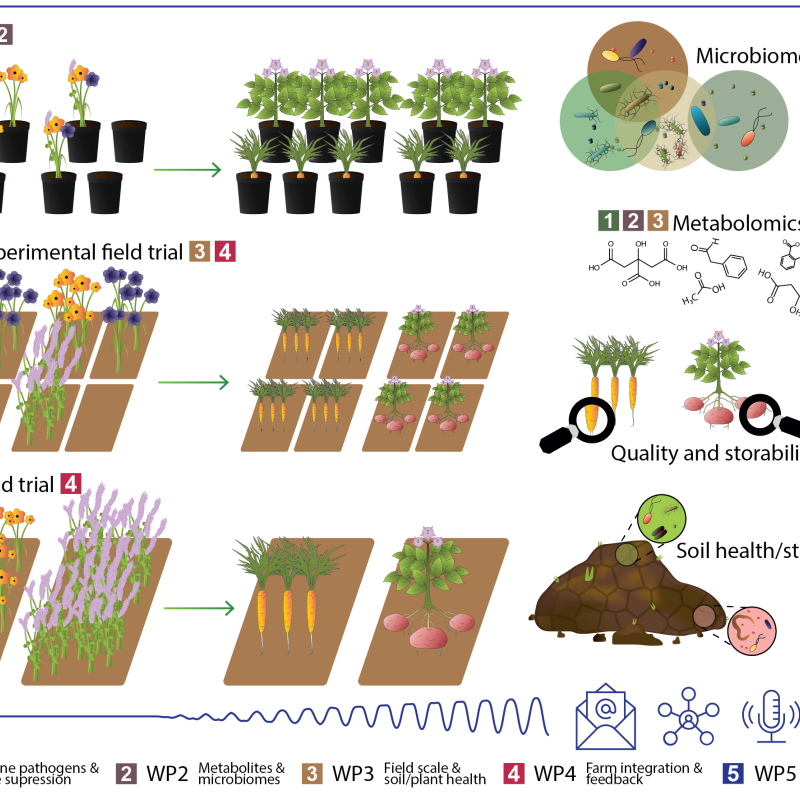
Cropdrive aims to identify a selection of cover crops suitable for use in root vegetable and potato production with beneficial impacts on both soil and plant health, and greenhouse gas exchange.