
Anders Aas
Forsker
Forfattere
Thiago Inagaki Frederik Bøe Ievina Sturite Meike S. Bärmann Franziska Bucka Alice Budai Anders Aas Daniel RasseSammendrag
In high-latitude arable systems (63.9°N), short growing seasons and cold climates often constrain regenerative practices. This study investigates how cover crop (CC) diversity influences the synergy among root development, carbon (C) persistence, and nutrient (N and P) dynamics within a barley (Hordeum vulgare L.)-oat (Avena sativa) rotation. Over three years, we evaluated a gradient of CC intercropping complexity using a randomized complete block design. Treatments were: (1) Control (barley/oat without NPK), (2) Biochar-Fertilizer (barley/oat + NPK + 1.8 Mg ha-1 year-1 biochar), (3) Monocrop (barley/oat), (4) Ryegrass (barley + ryegrass), (5) Clover (barley + ryegrass + white/red clover), and (6) Chicory (barley + ryegrass + red clover + chicory + bird’s-foot trefoil). We quantified root biomass, soil organic matter (SOM) fractions, specifically Mineral-Associated Organic Matter (MAOM) and Particulate Organic Matter (POM), aggregate stability, nutrient stocks, and microbial abundance via qPCR. The CCs sown shortly after barley were successfully established, with an average biomass of 1525 kg/ha, without compromising cereal yields, thereby confirming their viability in Nordic climates. A central finding was that root development served as the primary driver of organo-mineral associations. Ryegrass- and Clover-based systems produced significantly higher root biomass, which correlated strongly (p < 0.01) with MAOM stocks and total P acquisition. These systems stored 12 Mg/ha more MAOM-C and 1.1 Mg/ha more MAOM-N than the control at 0-20 cm depth. The inclusion of diverse functional traits in the complex five-species mixture significantly improved soil physical structure, yielding higher aggregate stability and lower bulk density. While CCs accumulated approximately 7 kg P/ha, the diverse mix optimized nutrient availability, whereas simpler mixtures showed higher C:P ratios, suggesting potential microbial P immobilization. Microbial abundance was consistently higher in multi-species treatments, indicating a more active biological environment. Ongoing analysis integrates cereal physiological data, focusing on the photosynthetic efficiency of oats in response to cultivation? regimes. Our findings bridge the gap between root morphology, plant physiology, and long-term SOM persistence, providing a strategic framework for using functional crop traits to enhance soil resilience and nutrient efficiency in cold-climate regions.
Sammendrag
Cover crops enhance soil quality and organic matter stability, yet the mechanisms linking belowground inputs to persistent soil organic matter (SOM) remain unclear. This study examined the effects of diversified cover cropping in barley systems on root biomass, SOM fractions, soil structure, microbial activity, and yield in central Norway (63.9° N), three years post-implementation. Six treatments were tested: (1) Control (barley without NPK), (2) Biochar-Fertilizer (barley + NPK + 3 Mg ha⁻¹ biochar), (3) Monocrop (barley), (4) Ryegrass (barley + ryegrass), (5) Clover (barley + ryegrass + white/red clover), and (6) Chicory (barley + ryegrass + red clover + chicory + bird’s-foot trefoil). Ryegrass and Clover systems produced 28.65 g m-² more root biomass at 0–13 cm (p < 0.05) and, along with Monocrop, stored 2.2 Mg ha-¹ more mineral-associated organic matter (MAOM) carbon and 0.2 Mg ha-¹ more MAOM nitrogen at 0–20 cm than other treatments. The Chicory system improved soil structure and biology, with higher aggregate stability, lower bulk density, and greater microbial abundance. Barley yields remained consistent across treatments, suggesting that cover cropping and low biochar inputs do not reduce productivity. Strong correlations (p < 0.01) between root biomass and MAOM stocks highlight root development as a key driver of SOM stabilization via organo-mineral associations. These findings underscore the role of root-enhancing cover crops in promoting MAOM formation and long-term SOM persistence, offering valuable insights for sustainable soil management.
Forfattere
Thiago Inagaki Frederik Bøe Ievina Sturite Meike Sophie Bärmann Franziska Bucka Alice Budai Anders Aas Daniel RasseSammendrag
High-latitude regions pose challenges for soil organic matter (SOM) sequestration and for improving soil fertility due to low temperatures, which shorten growing seasons and promote off-season nutrient leaching. Even long-term experiments on conservation practices have shown only modest increases in C storage. Nonetheless, persistent SOM fractions, such as mineral-associated organic matter (MAOM), have been shown to improve relatively quickly through conservation practices in temperate regions, which could be key in high-latitude regions. MAOM is an important SOM fraction not only for promoting carbon (C) storage but also for providing an available form of nitrogen (N) for plant nutrition. In this study, we show that, in Norwegian agriculture (63.9°N), MAOM (C and N) stocks improved only after three years of implementing cover crop systems that combined 1 to 4 cover crops with cereals (barley or oats) intercropped simultaneously (12 Mg ha-1 for C and 1.1 Mg ha-1 for N in the 0-20 cm layer more compared to unfertilized Control plots). Cover crops containing red and white clover and ryegrass efficiently increased the MAOM fraction in soil. An increase in root biomass and changes in root morphology were the primary factors linking cover crops to MAOM improvements in this field. In addition to benefits for SOM stocks, we recorded improvements in microbial abundance, soil structure, nutrient cycling, and cereal physiology. Our findings help to reframe MAOM as a bioavailable nutrient pool essential for soil health and nutrient cycling, which can be improved in the relatively short term through root development.
Divisjon for miljø og naturressurser
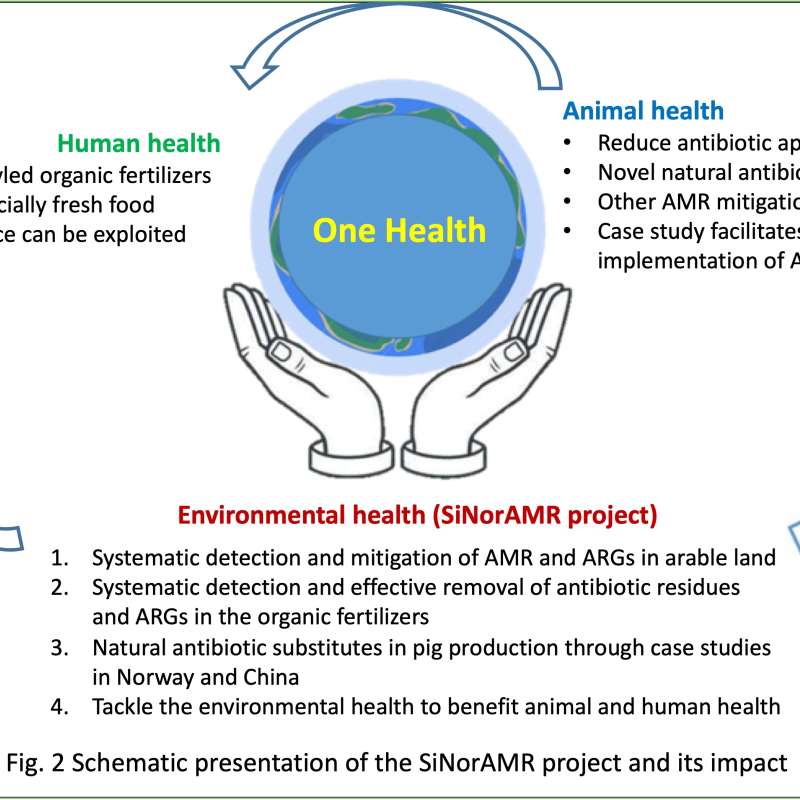
SiNorAMR
Full title: Collaborative and Knowledge-building Project Collaborative Project Systematic detection and mitigation of antimicrobial resistance in soil environment and animal health contributing to human health (SiNorAMR)
Divisjon for bioteknologi og plantehelse
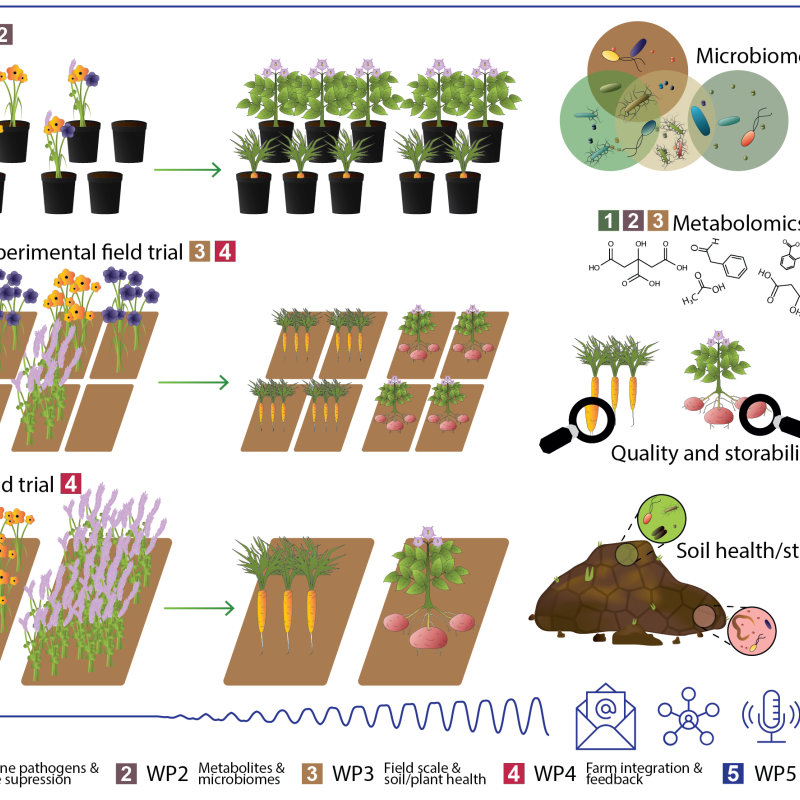
Cropdrive
Cropdrive aims to identify a selection of cover crops suitable for use in root vegetable and potato production with beneficial impacts on both soil and plant health, and greenhouse gas exchange.