Wenche Dramstad
Avdelingsleder/forskningssjef
(+47) 906 44 113
wenche.dramstad@nibio.no
Sted
Ås - Bygg O43
Besøksadresse
Oluf Thesens vei 43, 1433 Ås (Varelevering: Elizabeth Stephansens vei 21)
Vedlegg
CVBiografi
Jeg er utdannet naturforvalter (1990), og har en doktorgrad i landskapsøkologi fra NMBU (1997). Som landskapsøkolog er jeg spesielt opptatt av landskapets innhold og romlige struktur; hvordan landskapet fungerer som en mosaikk der ulike arealtyper og landskapselementer er geografisk fordelt, hvilken kvalitet de har og hvordan de endres over tid.
Jeg har jobbet i mange år med tilstand og endring i jordbrukslandskapet, med spesiell fokus på hvordan endringer i landskapets utforming kan ha betydning, for eksempel for biologisk mangfold og hvordan vi opplever landskapet. Dette inkluderer blant annet utvikling og drift av overvåkingsprogrammet for jordbrukets kulturlandskap, det såkalte 3Q-programmet, og indikatorer som kan brukes til å overvåke endringer.
Jeg kan dessuten litt om humler, litt om romlige analyser og GIS, er opptatt av jordvern og jordbruk, samt arealplanlegging. Jeg er medlem av Executive Commitee i IALE-Europe.
Jeg er professor II ved NMBU, der jeg underviser i landskapsøkologi (LAA370) og av og til veileder studenter med bachelor- eller masteroppgaver.
Sammendrag
The study focuses on ecosystem services, historical aspects, and natural diversity. Specifically, it assesses possible proxies for investigating a set of cultural ecosystem services from the Norwegian agricultural landscape. Agricultural areas on the Norwegian land cover map surrounded by a 100 m wide buffer zone were analyzed for recorded historical buildings, cultural heritage sites, red-listed vascular plant species (defined as being at varying degrees at risk of extinction), and red-listed nature types (defined as endangered or vulnerable). The results indicate significant contributions from agricultural landscapes with respect to historical buildings, cultural heritage sites, and red-listed plant species. Regarding red-listed nature types, the contributions were diverse. The ecosystem proxies investigated showed increasing distribution trends with increasing proportions of agricultural landscapes in the spatial units, with a sharp increase with smaller area sizes. However, for cultural heritage sites the trend was different when the proportion of the agricultural landscape was below 25%; it showed a very slow increase. In conclusion, the study highlights the agricultural landscape’s diverse contributions to the investigated ecosystem services in Norway, prompting the need for further research on additional ecosystem services to ensure the continued delivery of environmental and social well-being.
Sammendrag
Landscape ecology is repeatedly described as an applied science that can help reduce the negative effects of land-use and land-use changes on biodiversity. However, the extent to which landscape ecology is in fact contributing to planning and design processes is questioned. The aim of this paper is to investigate if and how landscape ecology can be integrated in a planning and design process, and to uncover possible problems that, e.g., landscape architects and planners, may face in such processes. Our conclusion, based on a case study from Asker municipality, Norway, is that such a landscape ecological approach has a lot to offer. However, it is difficult to exploit the potential fully for different reasons, e.g., biodiversity information tends to be specialized, and not easily used by planners and designers, and landscape ecological principles need an adaptation process to be applicable in a real-world situation. We conclude that for the situation to improve, landscape ecologists need to ease this process. In addition, we recommend collaboration across disciplinary boundaries, preferably with a common design concept as a foundation.
Sammendrag
Det er ikke registrert sammendrag
Forfattere
Martina Fernandez-Campo Beatriz Rodríguez-Morales Wenche Dramstad Wendy Fjellstad Emilio R. Diaz-VarelaSammendrag
The main objective of this work was to analyse how increased harvesting for bioenergy production might affect other Ecosystem Services (ES) in two Norwegian municipalities (Ringsaker and Voss). The aim was to identify locations where synergies or conflicts between ES could be expected. The spatial distribution of eight different ES (3 provision, 3 regulation and 2 cultural services) was modelled using information provided by land use spatial databases and additional data sources. Model parameters were set by integrating existing research and expert knowledge. Maps showing the level of provision of ES were analysed using a moving window to analyse scale dependence in the spatial distribution of ES provision. Map algebra was then used to identify areas providing multiple ES, thus defining the most important areas on which to focus the management of both synergies and trade-offs. Finally, specific ‘binary bundles’ maps, where bioenergy provision was compared with each of the other ES, were developed. The methodology proved its utility to assess the compatibility of bioenergy uses with other services. This straightforward approach is readily replicable in other regions and can be used as a decision support tool for planning and designing provision areas, and to ensure sustainable forest management approaches.
Forfattere
Wenche DramstadSammendrag
Det er ikke registrert sammendrag
Forfattere
Wenche Dramstad Wendy Fjellstad Geir-Harald Strand Henrik Forsberg Mathiesen Gunnar Engan Jogeir N. StoklandSammendrag
Det er ikke registrert sammendrag
Sammendrag
Gjengroing av område som tidlegare vart slått eller nytta som beite er ein av årsakene til at seminaturlege naturtypar er raudlista. Dette er ein stor trugsel for arter som til dømes solblom, dragehode og mogop.
Sammendrag
Når sommervarmen ligger tung over byen, søker vi mot skyggen under et stort tre. Det er ikke tilfeldig. Trær fungerer som naturens eget klimaanlegg og bidrar til å gjøre byer mer levelige når temperaturene stiger.
Sammendrag
Det er ikke registrert sammendrag
Divisjon for kart og statistikk
Integrering av klima, miljø og folkehelse i det norske matsystemet for å vurdere effektive, trygge og akseptable politiske alternativer
Norges matsystem utfordres ikke bare av interne målkonflikter, men også av økende ambisjoner knyttet til landbruk og mat fra andre politikkområder. Utslipp av klimagasser fra landbruket må reduseres, tap av natur og biologisk mangfold må stanses, og nye kostholdsanbefalinger forventes å flytte kostholdet mot mindre kjøttforbruk og -produksjon.
Divisjon for kart og statistikk
SoilMate
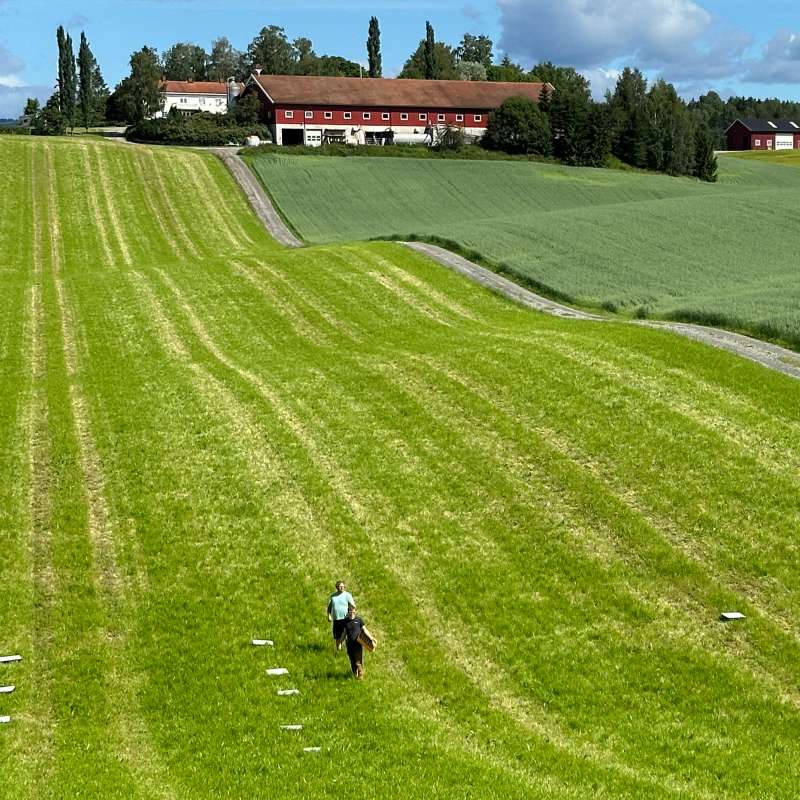
Det stilles mange og store og inngripende krav til dagens bonde, og det er mange ulike målsetninger å forholde seg til. Dette skaper fort usikkerhet, spesielt når bonden møter målkonflikter. For eksempel skal det produseres mer og mer effektivt samtidig som det blant annet skal tas en rekke miljøhensyn. Undersøkelser viser imidlertid at det er mulig å øke avlingene, nettofortjenesten og redusere klimagassutslipp.
FIREFLIES – Farming with nature