
Division of Forest and Forest Resources
FramSkog: projection of forest ecosystems – area, risks and ecological indicators
End: dec 2028
Start: dec 2025
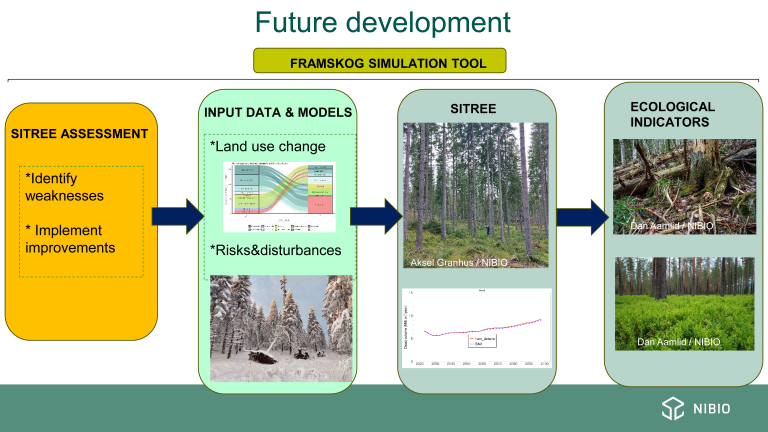
The purpose of the project is primarily to develop and test a projection tool (FramSkog). This tool will include sophisticated projections of the forest area (e.g., afforestation, reforestation) combined with the development of modules in SiTree for the projection of key indicators for biodiversity, and the implementation of models in SiTree for the prediction of large-scale disturbances in forests.
Project participants
Aksel Granhus Christian Wilhelm Mohr Gunnhild Søgaard Ken Olaf Storaunet Jørund Rolstad| Status | Active |
| Start - end date | 31.12.2025 - 30.12.2028 |
| Project manager | Ignacio Sevillano |
| Division | Division of Forest and Forest Resources |
| Department | Forest Management |
-
WP1. SiTree assessment. Assessment of the current SiTree projection tool, identification of weaknesses and implementation of potential improvements to improve the forecast.
-
WP2. Projections of forest area. Build and implement a model for land use changes considering transitions to and from forests.
-
WP3. Development of ecological indicators. Develop and implement existing ecological indicators (e.g., deadwood and bilberries) and new indicators (e.g., nature index).
-
WP4. Integrating potential damage risks into projections. Identify and implement most suitable models for assessing potential risks (e.g., wind, snow damage, bark beetles).
-
WP5. Scenario building and projections. Build different scenarios that can be tested with the tool. Create projections that illustrate the consequences for climate, biodiversity and industry.
Publications in the project
Abstract
Integrated decision support systems are fundamental for addressing complex issues related to forest ecosystems and the land use sector, such as climate, biodiversity or disturbances, and their impact on industry and society. Therefore, it is important to develop and use tools that can better incorporate potential challenges to forest ecosystems, socio-economic trends and political choices, and show their consequences for multiple natural resources. SiTree is a flexible, cross-platform and open-source individual-tree simulator framework written in R. Simulations produced using SiTree are currently and actively being used to inform policy decisions and in research, from carbon uptake under different management options to the provision of different forest ecosystem services, such as timber production and biodiversity. An overview of the current state with practical examples where SiTree simulation tool is being used will be presented. Future possibilities and capabilities for the development of SiTree will be discussed, with a focus, among others, on better linking land use to social trends and policy-making, predicting large-scale disturbances in forests and estimating the provision of forest ecosystem services.