
Project overview

FULCRUM Work Packages
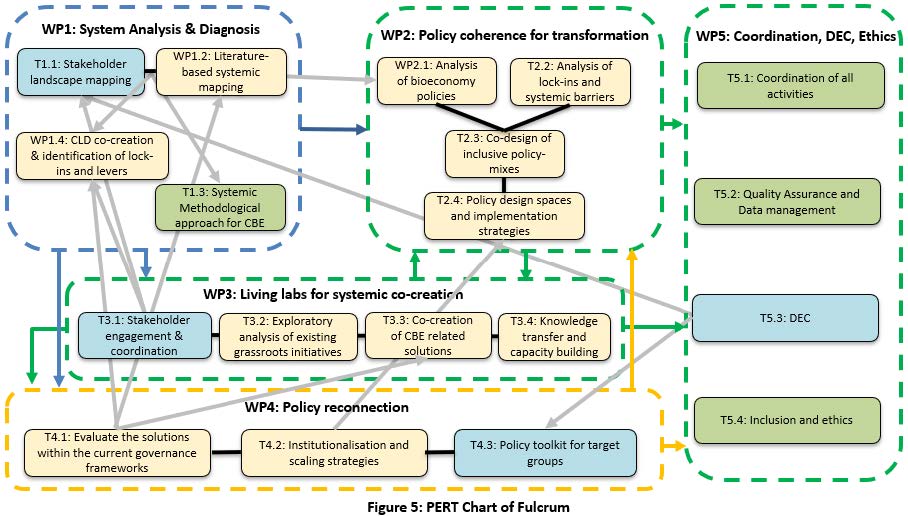
FULCRUM is organised into five interconnected Work Packages. Together, they guide the project from system analysis and stakeholder engagement to policy co-design, Living Lab experimentation, scaling and long-term impact.
WP1 – Scoping and Framing
Understanding the system
WP1 builds a shared understanding of the food systems and circular bioeconomy contexts addressed by FULCRUM. The work focuses on mapping stakeholders, resource flows, policies, governance structures and power relations within each Living Lab. It also identifies barriers, lock-ins and opportunities for change. Interviews, document analysis and participatory workshops are used to develop system maps and Causal Loop Diagrams. These tools help show how different actors, policies and practices are connected and where intervention may have the greatest impact.
Main objectives:
- Map key stakeholders and their roles.
- Analyse resource and by-product flows.
- Identify barriers, policy gaps and power imbalances.
- Develop system maps and Causal Loop Diagrams.
- Establish a common framework for the Living Labs.
WP2 – Enhancing Policy Design and Coherence
Improving how policies work together
WP2 examines how policies, regulations and support measures influence the transition towards more circular, fair and resilient food systems. The work looks at whether policies are coherent across sectors and governance levels, and whether they respond effectively to the realities faced by producers, businesses, communities and public authorities. Through policy analysis and co-design activities, stakeholders help identify inconsistencies, define priorities and develop more effective combinations of policy instruments.
Main objectives:
- Identify policy gaps, overlaps and inconsistencies.
- Analyse barriers created by regulations and administrative procedures.
- Compare policy intentions with implementation in practice.
- Co-design more coherent and context-sensitive policy solutions.
- Strengthen dialogue between policymakers and food-system actors.
WP3 – Living Labs for Systemic Co-creation
Testing solutions in real-world settings
WP3 is the core space for experimentation and co-creation in FULCRUM. The five Living Labs bring together producers, businesses, researchers, policymakers, civil-society organisations and local communities to jointly explore challenges and test practical solutions. The Living Labs focus not only on technological innovation, but also on new forms of collaboration, governance, business development and stakeholder participation.
Main objectives:
- Engage local actors in co-creation processes.
- Develop and test practical circular bioeconomy solutions.
- Explore new business and governance models.
- Strengthen collaboration across sectors and stakeholder groups.
- Support learning and exchange between the Living Labs.
WP4 – Policy Coherence and Upscaling
Turning local experience into wider change
WP4 assesses the results of the Living Labs and examines how successful approaches can be strengthened, transferred or scaled. The work considers whether solutions are technically feasible, economically viable, socially fair and compatible with existing policy and regulatory frameworks. Evidence from the five Living Labs is compared to identify common lessons, context-specific conditions and opportunities for wider uptake.
Main objectives:
- Evaluate the results of Living Lab activities.
- Identify conditions for scaling and replication.
- Assess economic, social, environmental and policy feasibility.
- Develop pathways for institutionalisation and long-term uptake.
- Contribute to the FULCRUM Food System Policy Toolkit.
WP5 – Coordination, Communication, Ethics and Data Management
Ensuring quality, visibility and responsible implementation
WP5 supports the overall coordination and effective delivery of FULCRUM. It ensures that activities across Work Packages and Living Labs remain connected, timely and consistent with the project’s objectives. It also manages communication, dissemination, ethics, data protection and quality assurance. Particular attention is given to responsible stakeholder engagement, protection of personal and commercially sensitive information, and transparent communication of project results.
Main objectives:
- Coordinate project implementation and partner collaboration.
- Monitor progress, quality, risks and deliverables.
- Manage communication, dissemination and stakeholder outreach.
- Ensure ethical research and responsible data management.
- Support the long-term visibility and use of FULCRUM results.
Contacts
Giovanna Ottaviani Aalmo
Research Scientist
-
Division of Food Production and Society
(+47) 980 30 422 giovanna.ottaviani.aalmo@nibio.no Office Location: Ås O43

Contacts
Giovanna Ottaviani Aalmo
Research Scientist
-
Division of Food Production and Society
(+47) 980 30 422 giovanna.ottaviani.aalmo@nibio.no Office Location: Ås O43